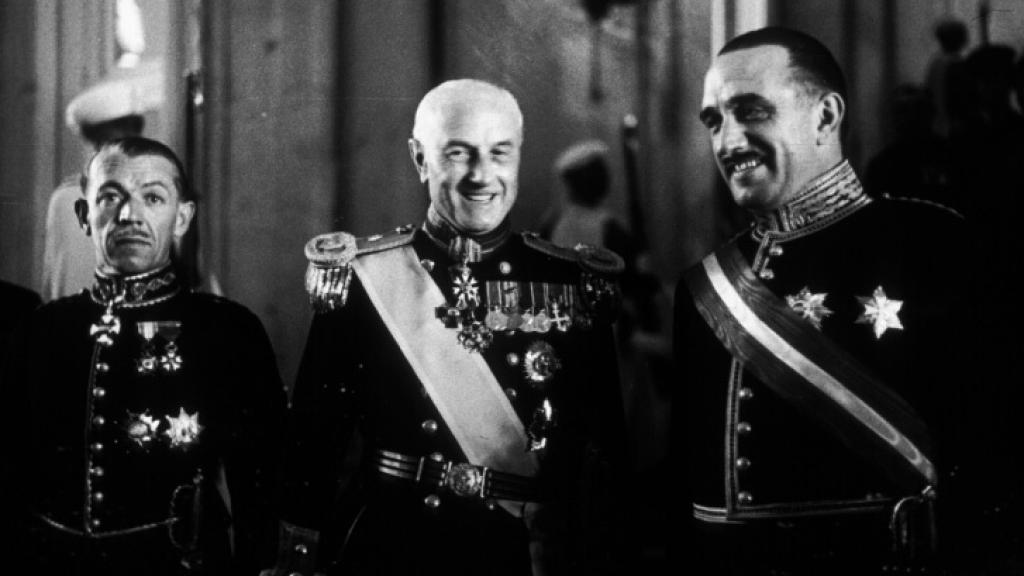
 Aristocrat, intelligence officer and politician: the story of the British figure who operated in the shadows between the Battle of Caporetto and the rise of Fascism
In conventional historical accounts, Sir Samuel Hoare is remembered primarily as one of the most enduring Conservative politicians of twentieth-century Britain.
He served as Secretary of State for Air, Secretary of State for India, Foreign Secretary, Home Secretary, First Lord of the Admiralty and, later, British ambassador to Francisco Franco’s Spain.
Before becoming one of the most recognisable representatives of the British establishment, however, Hoare had been an intelligence officer.
His activities during the First World War belong to a far less familiar story, one involving confidential reports, propaganda operations, covert funding, political intermediaries and networks created to defend British strategic interests abroad.
In Italy, particularly after the military disaster of Caporetto, Hoare emerged as a sophisticated political operator entrusted with influencing events at one of the most fragile moments in modern Italian history.
A Man Born into the Establishment
Samuel John Gurney Hoare was born in London in 1880 into an aristocratic family of Irish origin with longstanding connections to banking and finance.
His ancestors had founded Hoare’s Bank in the seventeenth century. Over the generations, the family entered the financial circles of the City of London and became connected with institutions that helped finance Britain’s industrial expansion and imperial power.
The family emblem featured a black horse, a figure deeply rooted in Celtic symbolism and traditionally associated with war, hidden knowledge and the passage between visible and invisible worlds.
Samuel Hoare’s path appeared to be marked out from the beginning.
He attended Harrow School, where numerous members of Britain’s ruling class had been educated, and later studied Modern History at New College, Oxford. By 1905, he was already working as private secretary to the Colonial Secretary. In 1910, he entered the House of Commons as a Conservative Member of Parliament.
His marriage to Lady Maud Lygon, daughter of the Earl Beauchamp, further consolidated his position within the aristocratic circles surrounding the Crown.
Hoare was therefore not an adventurer who accidentally entered the intelligence world. He was a product of the British governing system: educated in its institutions, admitted to its salons, connected to its financial networks and trained to protect its interests.
The Anti-Socialist Union
An important stage in Hoare’s political formation was his involvement with the Anti-Socialist Union, an organisation created amid growing concern over the Russian Revolution of 1905 and the expansion of the British labour movement.
The organisation opposed socialism, trade unionism and radical liberalism. It engaged in political propaganda, public campaigning and highly confrontational opposition to socialist groups.
Hoare became one of its most prominent representatives.
This experience helped shape his understanding of political conflict. Socialism was not merely an electoral opponent in his eyes. It was a threat to the entire imperial order, including the monarchy, the Anglican Church, the banking system and Britain’s global maritime power.
His conception of the Empire was almost sacred. It was a geopolitical temple to be defended not only through diplomacy and military strength, but also through less visible instruments: propaganda, influence over public opinion, intelligence gathering and covert political action.
From Russia to Military Intelligence
At the outbreak of the First World War, Hoare joined the Norfolk Yeomanry. Illness prevented him from being sent to the front, and his career took a different direction.
He was first employed in recruitment and was later transferred to military intelligence.
Hoare quickly learned Russian and was sent to Petrograd as a liaison officer between British intelligence and the Russian military command. He soon rose to the rank of lieutenant colonel and became head of the British military mission attached to the Russian armed forces.
During his stay in Petrograd, his name became associated with the obscure events surrounding the murder of Grigori Rasputin, the controversial adviser to the Russian imperial family.
Direct British involvement in the conspiracy remains disputed. Nevertheless, the presence of British agents in circles connected to the assassins generated suspicions that continued for decades.
After the Russian Revolution, London required Hoare’s services on another highly sensitive front: Italy.
The Mission after Caporetto
The Italian defeat at Caporetto in October 1917 caused alarm among the Allied governments.
Italy appeared politically unstable, militarily weakened and deeply divided by social conflict. British officials feared that Rome might seek a separate peace with the Central Powers or descend into revolutionary disorder.
Hoare was sent to the Italian capital as head of the British Military Intelligence Mission.
Its operational headquarters were located in Via delle Quattro Fontane in Rome. From there, Hoare supervised a network of officers, diplomats, journalists, politicians, informants and Italian intermediaries.
The immediate objective was to support the Italian war effort.
The broader objective was to ensure that Italy remained firmly integrated into the British strategic system even after the end of the war.
From London’s perspective, the danger did not come only from the Austro-German armies. British intelligence also regarded socialists, neutralists, sections of the Catholic world and former Prime Minister Giovanni Giolitti with suspicion.
Giolitti was seen as too closely associated with Italy’s old policy of balancing relations between Britain, France, Germany and Austria-Hungary.
The Battle for Public Opinion
Hoare understood that modern war was not fought only in the trenches.
It was also fought in newspapers, political associations, veterans’ organisations, public meetings and the streets.
The British mission therefore supported propaganda networks favourable to continuing the war. Around Hoare’s organisation moved nationalists, interventionists, journalists, industrialists, Freemasons, former soldiers and members of veterans’ associations.
Their political backgrounds were often very different, but they shared a common objective: preventing Italy from abandoning the conflict.
It was within this context that Benito Mussolini attracted British attention.
The former Socialist leader had become an outspoken interventionist and editor of Il Popolo d’Italia. He was regarded as useful because of his ability to influence public opinion, oppose neutralist socialists and mobilise sectors of the population in favour of the war.
Archival documents have been interpreted as evidence that British funds were provided to support Mussolini’s newspaper and propaganda activities.
The immediate objective was not necessarily to create a future dictator. It was to strengthen a political voice that supported the continuation of the war and opposed German influence in Italy.
History, however, often preserves instruments long after the emergency that created them has disappeared.
The Italian “Project”
British intelligence appears to have supported a broader political project designed to coordinate interventionists, veterans, assault troops, wounded soldiers and nationalist organisations.
These groups were expected to challenge socialist demonstrations, defend the war effort and prevent neutralist politicians from regaining control of the government.
During the war, British officials were careful not to encourage uncontrolled violence. A civil conflict in Italy would have been disastrous for the Allied cause.
Nevertheless, the political use of organised and militarised groups introduced a dangerous new element into Italian public life.
Violence was no longer merely a spontaneous consequence of political confrontation. It could be organised, directed and used to alter the balance of power.
Some historians have identified these wartime networks as part of the political and organisational environment from which Fascist squad violence later emerged.
This does not mean that Hoare single-handedly invented Italian Fascism.
The more plausible interpretation is that British intelligence helped finance, organise or legitimise certain political environments that later supplied members, methods or ideas to Mussolini’s movement.
Mussolini and British Interests
For Hoare and the British authorities, Mussolini was primarily a useful political instrument.
He opposed anti-war socialists, supported intervention and appealed to sectors of the veteran population. At that particular moment, his objectives coincided with British strategic interests.
London did not need to share all his ideas. It was enough that he served an immediate purpose.
This is one of the harshest realities of power politics. Allies are not always chosen because of shared principles. They are often selected because of temporary usefulness.
From the perspective of imperial strategy, Italian political forces could be treated as pieces on a much larger board.
Italy had to remain in the war, prevent Germany from strengthening its position in the Mediterranean and accept its place within the post-war European order.
Italian national aspirations mattered only as long as they did not conflict with the interests of the British Empire.
The Return to London
Hoare returned to Britain in 1919.
His intelligence career did not damage his political future. On the contrary, it strengthened it.
During the following decades, he held nearly every major office in the British government. He proved to be one of the great survivors of British politics.
Governments changed, international crises erupted and political alliances shifted, yet Hoare repeatedly returned to positions of influence.
In 1935, as Foreign Secretary, he played a role in the Anglo-German Naval Agreement, which allowed Adolf Hitler’s Germany to rebuild a substantial naval force.
During the same year, he became associated with the Hoare-Laval Plan, an attempt by Britain and France to end the Second Italo-Ethiopian War by granting Mussolini control over a large part of Ethiopia.
When the plan became public, it caused a major scandal and forced Hoare to resign.
Even this fall was temporary.
He later returned to government and, in 1940, was appointed British ambassador to Francoist Spain.
The Politician with Many Lives
Samuel Hoare moved through the first half of the twentieth century as an almost amphibious figure: aristocrat and intelligence operative, parliamentarian and covert organiser, diplomat and political strategist.
He was completely integrated into Britain’s constitutional system, yet he was also comfortable operating within the twilight zones of power.
His career demonstrates how artificial the separation between diplomacy, intelligence, finance and politics can be.
Behind public decisions, invisible structures often prepare the terrain, influence debate, finance selected organisations and identify political figures considered useful.
Hoare was not a marginal character.
He was one of the most refined components of the British imperial machine.
Britain and the Creation of a New Italian Order
The rise of Fascism cannot be explained solely as an internal Italian phenomenon.
Post-war economic crisis, social conflict, nationalism, the fear of revolution and the weakness of liberal institutions were all decisive factors.
Yet foreign powers were also attempting to shape Italy’s political future.
Britain feared a socialist revolution, a return of Giolitti, renewed Italian cooperation with Germany and the emergence of an excessively independent Italian policy in the Mediterranean.
To prevent these outcomes, British institutions supported politicians, newspapers and organisations considered compatible with their strategic objectives.
Some of those political environments later converged with Fascism.
This does not prove that Mussolini was simply a British creation, nor that the March on Rome was entirely planned in London.
It does suggest, however, that foreign intervention helped create part of the political climate, institutional networks and culture of mobilisation within which Fascism was able to grow.
The Long Shadow of Sir Samuel Hoare
Hoare died in 1959 as Viscount Templewood.
His public image remained that of a respectable Conservative statesman and a major figure in British politics between the two world wars.
His intelligence career reveals a more complex personality.
Behind the minister, diplomat and aristocratic gentleman stood a man who believed that politics could be shaped through confidential funds, propaganda, intelligence reports and temporary alliances with radical forces.
He viewed Italy not only as a sovereign nation, but also as a strategic territory to be monitored, influenced and, when necessary, redirected.
The story of Sir Samuel Hoare reminds us that empires rarely govern through armies and treaties alone.
They also act through private conversations, newspapers, financial networks, intelligence operations and carefully cultivated political relationships.
Like the black horse in his family emblem, imperial power often advances quietly through the landscape, carrying hidden messages and leaving tracks that become visible only many years later.
Commenti
Posta un commento